
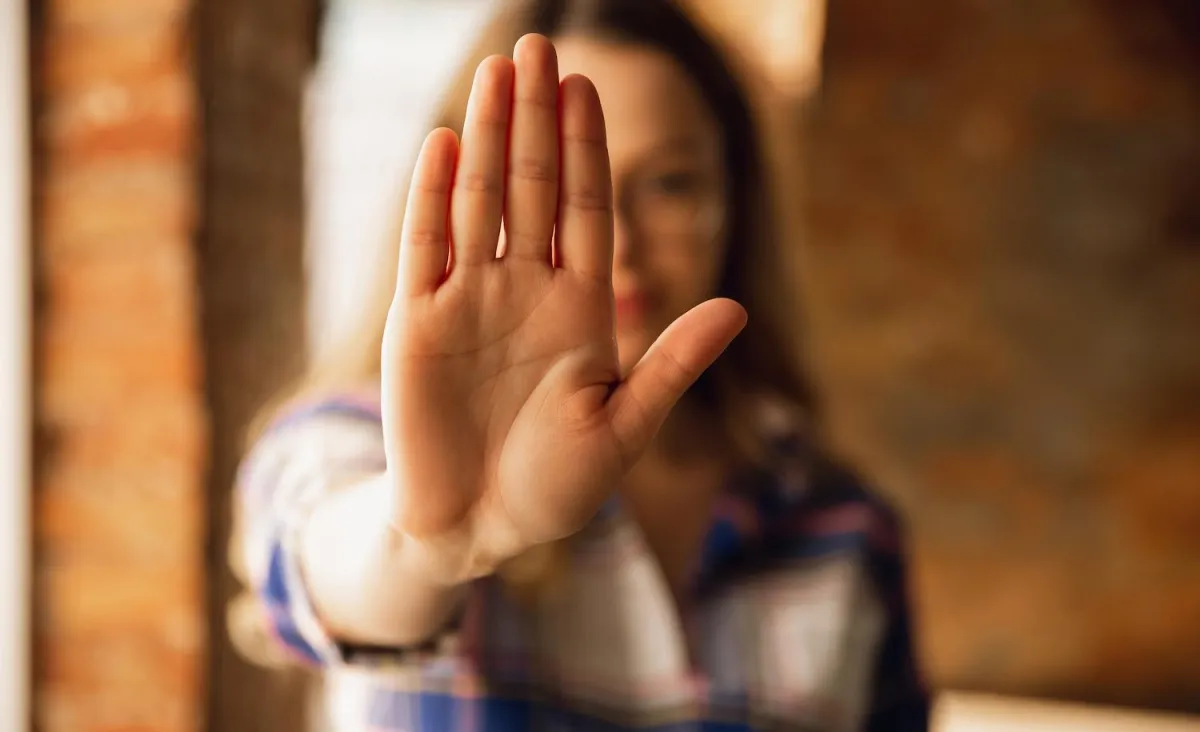
Permission to Say No (Even When They Refuse to Hear It)
I'm sure you've heard it said that "No is a complete sentence." And it absolutely is.
You are allowed to say "no" without explanation, justification, or excuse.
You are not obligated to compromise or offer an alternative resolution to make the person feel comfortable.
You are even allowed to say "no" simply because you don't want to—a lesson we should learn from small children, who are very good at asserting themselves without logic or reason.
But what happens when someone refuses to respect your "no"?
Do you see that as a "red flag" or do you buckle under the pressure?
Yesterday morning, I received some vulgar and threatening messages from a man who had reached out to me about personal coaching (a service I don't offer) and speaking at an organization he is affiliated with.
These messages were unsettling, to say the least; but I wasn't surprised.
Given my unfortunate life experience with narcissistic behavior, I saw the "red flags" from the get go:
Questioning my ability to make me prove myself.
Pressure to negotiate my boundaries, even using money to sway me.
Refusal of what is available and offered to all others.
Refusal to follow standard procedure and proper professional contracts.
Demand for isolation.
Use of threat and provocation to intimidate me when I held firm on my "no."
When you hold a firm boundary, the people who were benefiting from your lack of them will usually react with outrage. That isn't a sign that your boundary failed—it's proof that it was necessary.
HOW BOUNDARY PUSHERS TEST THE WATERS
Manipulative people often start with subtle tactics to determine your steadfastness, like simple questions for which your answers provide them with information about how loose your boundaries are.
They will ignore your suggestions and disrespect your boundaries, too, to test how pliable you are. For, if they see an opportunity to influence you to their will, they will push harder until they get their way.
When people like this do not get their way, then their behavior escalates. They attempt to cross major lines to bully you into submission. Holding firm beyond that forces them to face the fact that they are not as entitled as they believe, but can cause increased aggression because they realize they can't manipulate you. This is when you have to be very careful and cautious to protect your safety.
What to do when toxic people test your boundaries
Do not engage. Once someone pushes a little too hard or becomes unnecessarily hostile, stop responding. Toxic people view any response—even a defense—as attention and engagement, and will use such to invite more communication and harasshment.
Document first, Block second. Take clear, full screenshots showing the person's name, profile link, time and date stamps, and messages. Then block them on your phone and on social media.
Report them. Social media platforms treat abusive and harassing comments and messages as violations, and it is very easy to report these communications. For people you know personally or who live local to you, you can file a police report without filing charges. Provide the screenshots with your report, so that there is evidence of what occurred, in case the situation escalates.
Go no contact. There is no point in furthering any communication with someone who has ill intent.
Notify your support system. Tell your inner circle, partner, and trusted colleagues. Bringing the situation to light creates and increases your safety.
Log the harassment. Keep a dedicated digital or physical folder with dates, times, screenshots, and descriptions of every incident. If you ever need a restraining order or police involvement, a chronological log is your strongest asset.
The Power of Safe Harbors
The key to overcoming toxic people and situations is to hold firm in true safety.
Consider the people with whom you are emotionally and physically safe, and the places where your body and soul feel at peace. Those are your anchors. They will remind you of your power. Remain grounded in them. Gratitude for them will keep you grounded when toxic, boundary-destroying people attempt to strip you of that safety.
Saying "no" without guilt, without softening the blow, and without offering a lengthy justification takes practice. It requires unlearning the subconscious belief that keeping the peace is more important than keeping yourself safe.
I didn't learn to stand my ground overnight. It took years of recognizing red flags, breaking free from toxic cycles, and realizing that my peace was non-negotiable.
If you've ever struggled to hold your ground, or if you've ever felt the terrifying weight of someone trying to push past your "no," you aren't alone; and you don't have to apologize for protecting yourself.
Want to dive deeper into how I learned to trust my instincts and build unbreakable boundaries?
I share the unfiltered story of how I navigated boundary-testing in my first marriage in my best-selling and multi-award-winning debut memoir GASPING FOR AIR: THE STRANGLEHOLD OF NARCISSISTIC ABUSE. 📚
🖥️You can read the first 2 chapters for free by entering your email at danasdiaz.com.
And if this resonated, follow me on Instagram and let me know:
✨What's one area of your life where you're giving yourself permission to say a firm "no" this week?